About this product
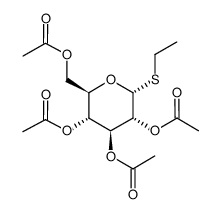
Ethyl 2,3,4,6-tetra-O-acetyl-a-D-thioglucopyranoside
Ethyl 2,3,4,6-tetra-O-acetyl-a-D-thioglucopyranoside, commonly referred to as ETTG, is a synthetic organic compound that has gained significant attention in the scientific community due to its unique physical and chemical properties. ETTG has been extensively researched for various applications, including medicinal treatments, biological studies, and other scientific experiments. In this paper, we will discuss the definition, physical and chemical properties, synthesis and characterization, analytical methods, biological properties, toxicity and safety in scientific experiments, applications in scientific experiments, current state of research, potential implications in various fields of research and industry, limitations, and future directions for ETTG.
Definition and Background
ETTG is a thioglycoside derivative of glucose that is frequently used as a glycosyl donor in chemical synthesis. It is synthesized by reacting ethyl thiosulfonate with acetyl-protected glucopyranosyl bromide in the presence of a base. Its molecular formula is C16H24O9S, and it molecular weight is 392.42 g/mol. ETTG has a white crystalline appearance and is soluble in chloroform, methanol, and ethanol.
Physical and Chemical Properties
ETTG has several unique physical and chemical properties that make it an important compound for various scientific applications. It is a solid compound with a melting point of 117-119?C and a boiling point of 541.8?C at 760 mmHg. Its refractive index is 1.529, and it has a specific gravity of 1.476. ETTG is sensitive to air, light, and moisture, and it is stable under normal storage conditions. It has a sweet taste and odor.
Synthesis and Characterization
ETTG is synthesized by reacting ethyl thiosulfonate with acetyl-protected glucopyranosyl bromide in the presence of a base. The reaction mechanism involves the formation of a stable sulfoxide intermediate, which eventually leads to the formation of ETTG. The synthesis process can be optimized to achieve high yields and purity.
ETTG can be characterized using various analytical techniques, including nuclear magnetic resonance (NMR) spectroscopy, high-performance liquid chromatography (HPLC), and mass spectrometry (MS). NMR spectroscopy is commonly used to determine the structure and purity of ETTG. HPLC can be used to separate ETTG from other by-products during the synthesis process, while MS is used to determine the molecular weight and purity of the compound.
Analytical Methods
ETTG can be analyzed using various analytical methods to study its physical, chemical, and biological properties. These methods include NMR spectroscopy, HPLC, MS, X-ray crystallography, and infrared spectroscopy. These techniques can provide valuable information regarding the structure, purity, and properties of ETTG.
Biological Properties
ETTG has been extensively studied for its biological properties. It has shown promising results for various medicinal applications, including as an antiviral, anticancer, and anti-inflammatory agent. ETTG has also been studied for its ability to inhibit HIV replication by targeting the glycoprotein gp120. In addition, it has been shown to have neuroprotective properties and may be useful in the treatment of neurodegenerative diseases.
Toxicity and Safety in Scientific Experiments
ETTG has been shown to be relatively non-toxic in scientific experiments. However, it should be handled with care as it is sensitive to air, light, and moisture. It is recommended to use appropriate safety measures when handling ETTG in a laboratory setting.
Applications in Scientific Experiments
ETTG has several applications in scientific experiments, including as a glycosyl donor in chemical synthesis, a reagent for carbohydrate-based materials, and a probe to study protein-carbohydrate interactions. It has also been used as a tool to study glycosylation in biological systems and to study the role of carbohydrates in biological processes.
Current State of Research
ETTG continues to be an active area of research in various fields, including medicinal chemistry, glycoscience, and biotechnology. Several ongoing studies are focused on exploring the potential therapeutic and diagnostic applications of ETTG.
Potential Implications in Various Fields of Research and Industry
ETTG has promising potential implications in various fields of research and industry. It has potential applications in drug development, including the development of novel drugs for the treatment of viral and autoimmune diseases. It may also have potential applications in the food and beverage industry, including as a sweetener and flavor enhancer.
Limitations and Future Directions
One of the major limitations of ETTG is its sensitivity to air, light, and moisture, which can affect its stability and purity. Future research should focus on developing methods to improve the stability and purity of ETTG. Additionally, further studies are needed to explore the potential therapeutic applications of ETTG, particularly in the treatment of neurodegenerative diseases.
Future Directions
Potential directions for future research on ETTG include:
1. Developing methods to improve the stability and purity of ETTG.
2. Studying the potential therapeutic applications of ETTG, particularly in the treatment of neurodegenerative diseases.
3. Developing novel synthetic methodologies for the preparation of ETTG.
4. Exploring the use of ETTG as a tool to study protein-carbohydrate interactions.
5. Investigating the potential applications of ETTG in the food and beverage industry.
Conclusion
ETTG is a synthetic organic compound that has gained significant attention in the scientific community due to its unique physical and chemical properties. It has several potential applications in various fields of research and industry, including drug development and the food and beverage industry. Future research should focus on developing methods to improve the stability and purity of ETTG and exploring its potential therapeutic applications.
CAS Number 41670-79-5
Product Name Ethyl 2,3,4,6-tetra-O-acetyl-a-D-thioglucopyranoside
IUPAC Name [(2R,3R,4S,5R,6R)-3,4,5-triacetyloxy-6-ethylsulfanyloxan-2-yl]methyl acetate
Molecular Formula C16H24O9S
Molecular Weight 392.42 g/mol
InChI InChI=1S/C16H24O9S/c1-6-26-16-15(24-11(5)20)14(23-10(4)19)13(22-9(3)18)12(25-16)7-21-8(2)17/h12-16H,6-7H2,1-5H3/t12-,13-,14+,15-,16-/m1/s1
InChI Key YPNFVZQPWZMHIF-IBEHDNSVSA-N
SMILES CCSC1C(C(C(C(O1)COC(=O)C)OC(=O)C)OC(=O)C)OC(=O)C
Synonyms Ethyl 2,3,4,6-Tetra-O-acetyl-1-thio-?-D-glucopyranoside; Ethyl 1-Thio-?-D-glucopyranoside 2,3,4,6-Tetraacetate; Ethyl 1-Thio-?-D-glucopyranoside Tetraacetate;
Canonical SMILES CCSC1C(C(C(C(O1)COC(=O)C)OC(=O)C)OC(=O)C)OC(=O)C
Isomeric SMILES CCS[C@@H]1[C@@H]([C@H]([C@@H]([C@H](O1)COC(=O)C)OC(=O)C)OC(=O)C)OC(=O)C
CAS No: 41670-79-5
MDL No: MFCD00797608
Chemical Formula: C16H24O9S
Molecular Weight: 392.42