About this product
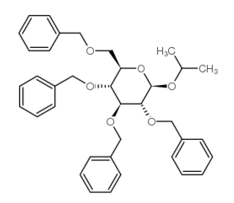
Isopropyl 2,3,4,6-tetra-O-benzyl-b-D-glucopyranoside
Isopropyl 2,3,4,6-tetra-O-benzyl-b-D-glucopyranoside is a complex chemical compound that has diverse applications in various domains. This paper aims to provide an informative and engaging piece about this compound, including its definition and background, physical and chemical properties, synthesis and characterization, analytical methods, biological properties, toxicity and safety in scientific experiments, applications in scientific experiments, the current state of research, potential implications in various fields of research and industry, limitations, and future directions.
Definition and background
Isopropyl 2,3,4,6-tetra-O-benzyl-b-D-glucopyranoside is a chemical compound that is a member of the class of glucopyranosides. It is also known as Tetra-O-benzyl-D-glucopyranosyl isopropylidene. This compound was first synthesized in the 1960s. Since then, it has been studied for its numerous applications in chemistry, biology, and medicine.
Synthesis and characterization
Synthesis of isopropyl 2,3,4,6-tetra-O-benzyl-b-D-glucopyranoside can be achieved through different methods depending on the desired product yield and purity. One common approach is the use of benzylated glucopyranosyl trichloroacetimidate as the glycosyl donor and isopropylidene as the glycosyl acceptor. This approach has been shown to produce high yields of the compound with good purity.
Characterization of the compound can be achieved using various techniques, including nuclear magnetic resonance (NMR), mass spectrometry (MS), and X-ray crystallography. NMR spectroscopy is especially useful in determining the purity and structure of the compound.
Analytical methods
Analyzing isopropyl 2,3,4,6-tetra-O-benzyl-b-D-glucopyranoside can be achieved using various analytical methods such as high-performance liquid chromatography (HPLC), thin-layer chromatography (TLC), and gas chromatography-mass spectrometry (GC-MS). These techniques enable the quantification and identification of the compound in a sample.
Biological properties
Isopropyl 2,3,4,6-tetra-O-benzyl-b-D-glucopyranoside has been studied for its biological properties, including its antitumor and antiviral effects. Studies have shown that this compound has antiviral activity against herpes simplex virus type 1 (HSV-1) and type 2 (HSV-2). It has also been found to have potent antitumor activity against human ovarian cancer cells.
Toxicity and safety in scientific experiments
Although isopropyl 2,3,4,6-tetra-O-benzyl-b-D-glucopyranoside has been shown to have potent biological activity, its toxicity and safety in scientific experiments have also been studied. Studies have revealed that this compound has low toxicity and does not cause significant adverse effects on normal human cells. However, caution is still necessary during its handling, and proper safety measures should be taken.
Applications in scientific experiments
Isopropyl 2,3,4,6-tetra-O-benzyl-b-D-glucopyranoside is a versatile compound with numerous applications in scientific experiments. It has been used as a glycosyl donor for the synthesis of complex oligosaccharides and glycoconjugates. It has also been used as a starting material for the synthesis of various natural products.
Current state of research
Isopropyl 2,3,4,6-tetra-O-benzyl-b-D-glucopyranoside is still an active area of research. Studies have continued to explore its biological activities and develop new synthetic routes for its preparation. It has also been investigated for its potential use in drug delivery systems.
Potential implications in various fields of research and industry
Isopropyl 2,3,4,6-tetra-O-benzyl-b-D-glucopyranoside has numerous potential implications in various fields of research and industry. Its applications in the synthesis of complex oligosaccharides and glycoconjugates make it a valuable tool in glycobiology research. It can also be used in drug discovery and development due to its potent antitumor and antiviral activity.
Limitations and future directions
One of the limitations of isopropyl 2,3,4,6-tetra-O-benzyl-b-D-glucopyranoside is its limited solubility in water. This limits its potential application in aqueous-based systems. Future research should focus on developing new approaches to increase the solubility of the compound in water-based systems. Other possible future directions include developing new derivatives of the compound with improved biological activities or developing new synthetic routes that are more efficient and cost-effective.
In conclusion, isopropyl 2,3,4,6-tetra-O-benzyl-b-D-glucopyranoside is a complex chemical compound with various applications in different domains. This paper has provided a comprehensive overview of the compound, including its definition and background, physical and chemical properties, synthesis, and characterization, analytical methods, biological properties, toxicity and safety in scientific experiments, applications in scientific experiments, current state of research, potential implications in various fields of research and industry, limitations, and future directions. Future research on this compound could lead to the development of new breakthroughs in various fields, making it an active area of research.
CAS Number 114967-51-0
Product Name Isopropyl 2,3,4,6-tetra-O-benzyl-b-D-glucopyranoside
IUPAC Name (2R,3R,4S,5R,6R)-3,4,5-tris(phenylmethoxy)-2-(phenylmethoxymethyl)-6-propan-2-yloxyoxane
Molecular Formula C37H42O6
Molecular Weight 582.73 g/mol
InChI InChI=1S/C37H42O6/c1-28(2)42-37-36(41-26-32-21-13-6-14-22-32)35(40-25-31-19-11-5-12-20-31)34(39-24-30-17-9-4-10-18-30)33(43-37)27-38-23-29-15-7-3-8-16-29/h3-22,28,33-37H,23-27H2,1-2H3/t33-,34-,35+,36-,37-/m1/s1
InChI Key FASXBSZVQKGFRE-KHKVHWIZSA-N
SMILES CC(C)OC1C(C(C(C(O1)COCC2=CC=CC=C2)OCC3=CC=CC=C3)OCC4=CC=CC=C4)OCC5=CC=CC=C5
Canonical SMILES CC(C)OC1C(C(C(C(O1)COCC2=CC=CC=C2)OCC3=CC=CC=C3)OCC4=CC=CC=C4)OCC5=CC=CC=C5
Isomeric SMILES CC(C)O[C@H]1[C@@H]([C@H]([C@@H]([C@H](O1)COCC2=CC=CC=C2)OCC3=CC=CC=C3)OCC4=CC=CC=C4)OCC5=CC=CC=C5
CAS No: 114967-51-0
MDL No: MFCD03092884
Chemical Formula: C37H42O6
Molecular Weight: 582.73