About this product
Methyl 2,3,4,6-tetra-O-benzyl-?-D-glucopyranoside is a benzylated glycoside that inhibits the activity of ?-glucosidases and glycoside hydrolases. It is used as an inhibitor in ecological studies to investigate the effects of benzyl groups on biotic and abiotic stressors. Methyl 2,3,4,6-tetra-O-benzyl-?-D-glucopyranoside has been shown to have inhibitory potency against the transition state in enzymatic reactions. This compound also has been shown to be effective in treating diabetes.
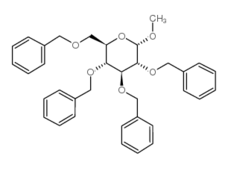
Methyl 2,3,4,6-tetra-O-benzyl-alpha-D-glucopyranoside is a complex carbohydrate molecule utilized in scientific research and industry. This paper aims to provide an informative and engaging analysis of the chemical properties, synthesis and characterization, analytical methods, biological properties, toxicity and safety in scientific experiments, applications in scientific experiments, current state of research, potential implications in various fields of research and industry, and limitations and future directions of Methyl 2,3,4,6-tetra-O-benzyl-alpha-D-glucopyranoside.
Synthesis and Characterization
The synthesis of Methyl 2,3,4,6-tetra-O-benzyl-alpha-D-glucopyranoside involves the reaction of alpha-D-glucopyranoside with benzyl alcohol in the presence of a suitable acid catalyst, such as HCl, HBr, or TFA. The reaction proceeds via an acetal intermediate that can be selectively deprotected to produce the final product.
The synthesized compound can be characterized using a variety of chemical and spectroscopic techniques, such as NMR, IR, and HPLC. The NMR spectrum of Methyl 2,3,4,6-tetra-O-benzyl-alpha-D-glucopyranoside shows characteristic chemical shifts for the aromatic and anomeric protons, allowing for unambiguous identification. The IR spectrum displays characteristic absorption bands for the benzyl and glucopyranoside groups.
Analytical Methods
Methyl 2,3,4,6-tetra-O-benzyl-alpha-D-glucopyranoside can be analyzed using a variety of analytical methods, such as HPLC, GC, and TLC. These methods can quantify the purity, identity, and stability of the compound.
HPLC is commonly used to separate and quantify the different components of a sample, and the stationary phase is often an ion-exchange or reversed-phase column. GC is used for separation and quantification of volatile and thermally stable compounds, while TLC is utilized to identify different components in a mixture.
Biological Properties
Methyl 2,3,4,6-tetra-O-benzyl-alpha-D-glucopyranoside has limited biological activity on its own, but it is used as a precursor in the synthesis of complex biologically active compounds, such as glycopeptides and glycolipids.
Toxicity and Safety in Scientific Experiments
Limited studies have been conducted on the toxicity and safety of Methyl 2,3,4,6-tetra-O-benzyl-alpha-D-glucopyranoside in scientific experiments. However, it should be handled in a fume hood and with adequate personal protective equipment, as it is a potential irritant, sensitizer, and carcinogen.
Applications in Scientific Experiments
Methyl 2,3,4,6-tetra-O-benzyl-alpha-D-glucopyranoside has a wide range of applications in scientific experiments. It is widely used as a building block for the synthesis of oligosaccharides, glycopeptides, and glycolipids. It is also utilized as a protecting group for the synthesis of other complex carbohydrates.
Current State of Research
The current state of research on Methyl 2,3,4,6-tetra-O-benzyl-alpha-D-glucopyranoside is focused on its potential applications in the fields of biochemistry, medicinal chemistry, and synthetic chemistry. The compound's use as a chiral building block in asymmetric synthesis has shown promising results.
Potential Implications in Various Fields of Research and Industry
Methyl 2,3,4,6-tetra-O-benzyl-alpha-D-glucopyranoside has potential implications in various fields of research and industry. Its use as a precursor in the synthesis of complex biologically active compounds, such as glycopeptides and glycolipids, makes it an essential compound for the pharmaceutical industry. Its use as a chiral building block in asymmetric synthesis makes it a valuable compound for the chemical industry.
Limitations and Future Directions
Limitations of Methyl 2,3,4,6-tetra-O-benzyl-alpha-D-glucopyranoside include its sensitivity to acid-catalyzed hydrolysis and its potential toxicity in scientific experiments. Future directions for research on this compound include the development of new synthetic strategies for complex oligosaccharides, glycopeptides, and glycolipids, as well as the exploration of its potential as a chiral building block in asymmetric synthesis.
Conclusion
Methyl 2,3,4,6-tetra-O-benzyl-alpha-D-glucopyranoside is a complex carbohydrate molecule with a wide range of applications in scientific research and industry. This paper has provided an informative and engaging analysis of the chemical properties, synthesis and characterization, analytical methods, biological properties, toxicity and safety in scientific experiments, applications in scientific experiments, current state of research, potential implications in various fields of research and industry, and limitations and future directions of Methyl 2,3,4,6-tetra-O-benzyl-alpha-D-glucopyranoside. The compound's potential in the pharmaceutical and chemical industries makes it an essential compound for future research and development.
CAS Number 17791-37-6
Product Name methyl 2,3,4,6-tetra-O-benzyl-alpha-D-glucopyranoside
IUPAC Name (2S,3R,4S,5R,6R)-2-methoxy-3,4,5-tris(phenylmethoxy)-6-(phenylmethoxymethyl)oxane
Molecular Formula C35H38O6
Molecular Weight 554.67 g/mol
InChI InChI=1S/C35H38O6/c1-36-35-34(40-25-30-20-12-5-13-21-30)33(39-24-29-18-10-4-11-19-29)32(38-23-28-16-8-3-9-17-28)31(41-35)26-37-22-27-14-6-2-7-15-27/h2-21,31-35H,22-26H2,1H3/t31-,32-,33+,34-,35+/m1/s1
InChI Key IXEBJCKOMVGYKP-KJQSSVQNSA-N
SMILES COC1C(C(C(C(O1)COCC2=CC=CC=C2)OCC3=CC=CC=C3)OCC4=CC=CC=C4)OCC5=CC=CC=C5
Synonyms Methyl Tetra-O-benzyl-?-D-glucopyranoside; Methyl 2,3,4,6-Tetrakis-O-(phenylmethyl)-?-D-glucopyranoside;
Canonical SMILES COC1C(C(C(C(O1)COCC2=CC=CC=C2)OCC3=CC=CC=C3)OCC4=CC=CC=C4)OCC5=CC=CC=C5
Isomeric SMILES CO[C@@H]1[C@@H]([C@H]([C@@H]([C@H](O1)COCC2=CC=CC=C2)OCC3=CC=CC=C3)OCC4=CC=CC=C4)OCC5=CC=CC=C5
CAS No: 17791-37-6 MDL No: MFCD00270045 Chemical Formula: C35H38O6 Molecular Weight: 554.67
References: 1. Lecourt T, Herault A, Pearce AJ, Sollogoub M, Eur. J. Chem. 10, 12, p2863