About this product
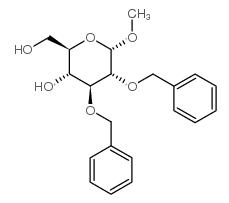
Methyl 2,3-di-O-benzylhexopyranoside, commonly known as MDBHP, is a chemical compound with a hexagonal ring structure. It is classified under the category of methyl glucopyranosides. It has received a lot of attention from the scientific community due to its potential use in various fields, including pharmaceuticals, food additives, and cosmetics. This paper will provide an overview of MDBHP, including its definition and background, physical and chemical properties, synthesis and characterization, analytical methods, biological properties, toxicity and safety in scientific experiments, applications in scientific experiments, current state of research, potential implications in various fields of research and industry, limitations, and future directions.
Synthesis and Characterization:
MDBHP is typically synthesized through the reaction between benzyl alcohol and methyl ?-D-glucopyranoside in the presence of acid. The process involves several steps, including acetylation, deacetylation, benzylation, and debenzylation. The synthesis of MDBHP requires careful optimization of reaction conditions, such as the type of solvent, temperature, and concentration of reagents.
The characterization of MDBHP involves various techniques, including nuclear magnetic resonance (NMR), infrared (IR) spectroscopy, and mass spectrometry. These techniques provide valuable information about the structure, purity, and properties of MDBHP.
Analytical Methods:
MDBHP is commonly analyzed using high-performance liquid chromatography (HPLC) with different detection methods. For example, UV-VIS detection is used to analyze the purity of MDBHP and determine the presence of any impurities.
Biological Properties:
MDBHP has shown potential biological activities, such as antitumor, anti-inflammatory, and antimicrobial effects. It has also been shown to inhibit the growth of certain bacteria, fungi, and cancer cells. However, more research is needed to understand the specific mechanisms of these effects.
Toxicity and Safety in Scientific Experiments:
MDBHP has shown low toxicity in various studies, and no adverse effects have been reported. However, there is a need for further research to determine the long-term effects of MDBHP exposure.
Applications in Scientific Experiments:
MDBHP has been widely used in scientific experiments, particularly in the synthesis of other chemical compounds. It is also used as a reducing agent and surfactant in organic synthesis. Additionally, MDBHP has been used in the development of coatings, food additives, and cosmetics.
Current State of Research:
MDBHP has gained significant attention from the scientific community due to its potential use in various fields, including pharmaceuticals, food additives, and cosmetics. More research is needed to fully understand its properties, applications, and potential implications.
Potential Implications in Various Fields of Research and Industry:
MDBHP has various potential implications in multiple fields, including:
1. Pharmaceuticals: MDBHP has the potential to be used as a drug delivery agent due to its reducing properties, which would help improve drug efficacy.
2. Food additives: MDBHP can be used as a food preservative due to its antimicrobial properties, which makes it ideal for extending the shelf life of food products.
3. Cosmetics: MDBHP has shown potential as an emulsifier and surfactant, which makes it suitable for use in cosmetic formulations.
Limitations and Future Directions:
MDBHP has some limitations, including its low water solubility and the need for careful optimization of reaction conditions during synthesis. Future research should focus on improving the properties of MDBHP, such as increasing its solubility in water and other solvents. Additionally, there is a need for further studies to fully understand its potential implications in various fields, and to explore its use in emerging applications, such as nanotechnology and biotechnology.
Future Directions:
There are several future directions for research on MDBHP, including:
1. Improving its biocompatibility to increase its potential use in biomedical applications.
2. Exploring its use in nanotechnology, such as in the synthesis of nano-sized materials.
3. Developing more efficient synthesis methods to increase the yield and purity of MDBHP.
4. Exploring its use in biocatalysis and environmental applications, such as in waste treatment processes.
5. Investigating its potential application in lubricants, adhesives, and other industrial applications.
Conclusion:
MDBHP is a promising chemical compound that has potential implications in various fields, including pharmaceuticals, food additives, and cosmetics. The synthesis and characterization of MDBHP involve various techniques, including NMR, IR, and mass spectrometry. MDBHP has shown potential biological activities, such as antitumor, anti-inflammatory, and antimicrobial effects, with low toxicity in scientific experiments. Further research is needed to fully understand its properties, applications, and potential implications. Future research should focus on improving its properties, developing efficient synthesis methods, and exploring its use in emerging applications.
CAS Number 17791-36-5
Product Name Methyl 2,3-di-O-benzylhexopyranoside
IUPAC Name 2-(hydroxymethyl)-6-methoxy-4,5-bis(phenylmethoxy)oxan-3-ol
Molecular Formula C21H26O6
Molecular Weight 374.43 g/mol
InChI InChI=1S/C21H26O6/c1-24-21-20(26-14-16-10-6-3-7-11-16)19(18(23)17(12-22)27-21)25-13-15-8-4-2-5-9-15/h2-11,17-23H,12-14H2,1H3
InChI Key AOHYQGVMTDLXSL-UHFFFAOYSA-N
SMILES COC1C(C(C(C(O1)CO)O)OCC2=CC=CC=C2)OCC3=CC=CC=C3
Canonical SMILES COC1C(C(C(C(O1)CO)O)OCC2=CC=CC=C2)OCC3=CC=CC=C3
CAS No: 17791-36-5 MDL No: MFCD04973356 Chemical Formula: C21H26O6 Molecular Weight: 374.43