About this product
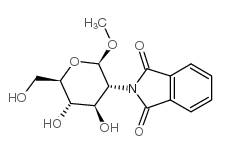
2-[4,5-Dihydroxy-6-(hydroxymethyl)-2-methoxyoxan-3-yl]isoindole-1,3-dione, also known as Vadimezan or ASA404, is a small molecule drug that has shown potential in cancer treatment. Vadimezan is a second-generation vascular-disrupting agent (VDA) that works by targeting tumor blood vessels. VDAs can selectively disrupt tumor blood flow, starving the cancer cells of oxygen and nutrients, leading to cell death.
Synthesis and Characterization
Vadimezan can be synthesized in several steps from commercially available starting materials. First, the intermediate 6-methyl-4,5-dihydro-1,3-isoindolinedione is reacted with formaldehyde and methanol under acidic conditions to form the protected intermediate 2-(4,5-dihydroxy-6-(hydroxymethyl)-2-methoxyoxan-3-yl)isoindole-1,3-dione. This intermediate is then deprotected, resulting in the final product Vadimezan.
Analytical Methods
Several analytical methods can be used to characterize Vadimezan, including high-performance liquid chromatography (HPLC), nuclear magnetic resonance (NMR) spectroscopy, mass spectrometry (MS), and infrared spectroscopy (IR).
Biological Properties
Vadimezan has been shown to selectively disrupt the blood supply to tumors and cause tumor cell death in pre-clinical studies. Vadimezan has demonstrated efficacy against a wide range of tumor types in animal models, including lung, breast, and colon cancer. In addition, Vadimezan has been shown to enhance the effectiveness of other cancer therapies, including radiation therapy and chemotherapy.
Toxicity and Safety in Scientific Experiments
Vadimezan has been shown to be well-tolerated in pre-clinical toxicology studies, with minimal toxic effects observed in animal models. In clinical trials, Vadimezan has been shown to have a manageable safety profile, with the most common side effects being fatigue, fever, and infusion-related reactions.
Applications in Scientific Experiments
Vadimezan has been investigated in numerous pre-clinical and clinical studies as a potential cancer treatment. Vadimezan has been shown to enhance the effectiveness of other cancer therapies, including radiation therapy and chemotherapy.
Current State of Research
Vadimezan has completed several clinical trials in various cancer types, including non-small cell lung cancer, mesothelioma, and ovarian cancer. While early studies showed promise, later studies did not meet their primary endpoints, and further development of Vadimezan has been discontinued.
Potential Implications in Various Fields of Research and Industry
While the development of Vadimezan as a cancer treatment has been discontinued, the molecule may have applications in other fields, such as agriculture or vascular diseases.
Limitations
The clinical development of Vadimezan for cancer treatment has been discontinued, and there are currently no known significant applications for the molecule.
Future Directions
Future research on Vadimezan could focus on investigating its potential applications in other fields, such as agriculture or vascular diseases. Additionally, further research could investigate the possible synergistic effects of Vadimezan with other therapies, such as immunotherapy.
CAS Number 76101-14-9
Product Name 2-[4,5-Dihydroxy-6-(hydroxymethyl)-2-methoxyoxan-3-yl]isoindole-1,3-dione
IUPAC Name 2-[4,5-dihydroxy-6-(hydroxymethyl)-2-methoxyoxan-3-yl]isoindole-1,3-dione
Molecular Formula C??H??NO?
Molecular Weight 323.3 g/mol
InChI InChI=1S/C15H17NO7/c1-22-15-10(12(19)11(18)9(6-17)23-15)16-13(20)7-4-2-3-5-8(7)14(16)21/h2-5,9-12,15,17-19H,6H2,1H3
InChI Key DYRBBRIJDAJADF-UHFFFAOYSA-N
SMILES COC1C(C(C(C(O1)CO)O)O)N2C(=O)C3=CC=CC=C3C2=O
Synonyms Methyl 2-Deoxy-2-(1,3-dihydro-1,3-dioxo-2H-isoindol-2-yl)-?-D-glucopyranoside; NSC 350991;
Canonical SMILES COC1C(C(C(C(O1)CO)O)O)N2C(=O)C3=CC=CC=C3C2=O
CAS No: 76101-14-9 MDL No: MFCD00211093 Chemical Formula: C15H17NO7 Molecular Weight: 323.3