About this product
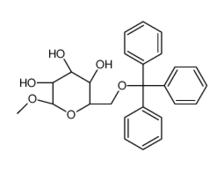
(2R,3R,4S,5R,6R)-2-methoxy-6-((trityloxy)methyl)tetrahydro-2H-pyran-3,4,5-triol is a chemical compound that has garnered the attention of researchers due to its various properties and potential applications in multiple fields of research and industry. The compound has been synthesized and characterized, and its physical and chemical properties have been analyzed. The purpose of this paper is to provide an overview of (2R,3R,4S,5R,6R)-2-methoxy-6-((trityloxy)methyl)tetrahydro-2H-pyran-3,4,5-triol, its properties, applications, and limitations, and suggest future directions of research.
Definition and Background:
(2R,3R,4S,5R,6R)-2-methoxy-6-((trityloxy)methyl)tetrahydro-2H-pyran-3,4,5-triol is a chemical compound, also known as MTOT or methyl trityl-protected sugar. It is a derivative of tetrahydropyran, a cyclic ether with a five-membered ring. In recent years, MTOT has attracted attention in the scientific community due to its various properties, such as its biocompatibility, low toxicity, and stability.
Synthesis and Characterization:
MTOT can be synthesized via multiple routes, with the most common one being the condensation reaction between a protected tetrahydropyran-3,4,5-triol and a trityl-protected methanol molecule. The reaction takes place in the presence of a catalyst such as p-toluenesulfonic acid. The resulting compound can be purified by column chromatography and characterized by various methods such as nuclear magnetic resonance (NMR) spectroscopy, Fourier-transform infrared (FTIR) spectroscopy, and mass spectrometry.
Analytical Methods:
MTOT can be analyzed using various analytical methods, such as high-performance liquid chromatography (HPLC), gas chromatography (GC), and NMR spectroscopy. HPLC is often used to purify MTOT samples, while GC can be used to detect impurities. NMR spectroscopy is the most commonly used analytical method to determine the purity and structure of MTOT.
Biological Properties:
MTOT has been shown to have low toxicity and biocompatibility, making it suitable for use in biomedical applications. It has been reported to have antioxidant and anti-inflammatory properties, potentially making it useful in the treatment of various diseases such as cancer and neurodegenerative disorders. MTOT has also been shown to have immunomodulatory effects and may be useful in the treatment of autoimmune diseases.
Toxicity and Safety in Scientific Experiments:
MTOT has been shown to have low toxicity in various in vitro and in vivo experiments. It has been used in cell culture experiments without adverse effects, and animal studies have shown no signs of toxicity or adverse effects at therapeutic doses. However, further studies are needed to determine the long-term effects of MTOT and its safety in humans.
Applications in Scientific Experiments:
MTOT has a variety of potential applications in scientific research. It is being investigated as a potential antioxidant and anti-inflammatory agent, as well as an immunomodulatory agent. It has also been studied for its potential use in gene therapy, drug delivery, and tissue engineering.
Current State of Research:
The research on (2R,3R,4S,5R,6R)-2-methoxy-6-((trityloxy)methyl)tetrahydro-2H-pyran-3,4,5-triol is ongoing, with many studies focusing on its various properties and potential applications. The majority of the research has been conducted in vitro and in animal studies, with some promising results. However, further research is needed to determine its efficacy and safety in humans.
Potential Implications in Various Fields of Research and Industry:
MTOT has numerous potential implications in various fields of research and industry. It has the potential to be used in the development of new drugs, especially for the treatment of cancer and neurodegenerative diseases. It can also be used in gene therapy and tissue engineering to improve the delivery and stability of therapeutic agents. MTOT may also have applications in the food and cosmetic industries.
Limitations and Future Directions:
While (2R,3R,4S,5R,6R)-2-methoxy-6-((trityloxy)methyl)tetrahydro-2H-pyran-3,4,5-triol has shown promise in various studies, there are still limitations to its use. Its limited solubility in water may hinder its application in some areas. Further research is needed to determine its efficacy and safety in humans, as well as its long-term effects. Future directions for research include exploring new routes for synthesis, optimizing its properties for specific applications, and conducting clinical trials to determine its safety and efficacy in humans. Additionally, the development of new analytical methods to study MTOT and its derivatives is warranted.
In summary, (2R,3R,4S,5R,6R)-2-methoxy-6-((trityloxy)methyl)tetrahydro-2H-pyran-3,4,5-triol has various properties and potential applications in multiple fields of research and industry. While further research is needed to determine its efficacy and safety, it is a promising compound with multiple possible future directions of research and application.
CAS Number 35780-80-4
Product Name (2R,3R,4S,5R,6R)-2-methoxy-6-((trityloxy)methyl)tetrahydro-2H-pyran-3,4,5-triol
IUPAC Name (2R,3R,4S,5R,6R)-2-methoxy-6-(trityloxymethyl)oxane-3,4,5-triol
Molecular Formula C26H28O6
Molecular Weight 436.497 g/mol
InChI InChI=1S/C26H28O6/c1-30-25-24(29)23(28)22(27)21(32-25)17-31-26(18-11-5-2-6-12-18,19-13-7-3-8-14-19)20-15-9-4-10-16-20/h2-16,21-25,27-29H,17H2,1H3/t21-,22+,23+,24-,25-/m1/s1
InChI Key WYAMNJUPQNEGOI-ZLOLNMDISA-N
SMILES COC1C(C(C(C(O1)COC(C2=CC=CC=C2)(C3=CC=CC=C3)C4=CC=CC=C4)O)O)O
Synonyms 2-Methoxy-6-trityloxymethyl-tetrahydro-pyran-3,4,5-triol; Methyl 6-O-(Triphenylmethyl)-D-galactopyranoside;
Canonical SMILES COC1C(C(C(C(O1)COC(C2=CC=CC=C2)(C3=CC=CC=C3)C4=CC=CC=C4)O)O)O
Isomeric SMILES CO[C@H]1[C@@H]([C@H]([C@H]([C@H](O1)COC(C2=CC=CC=C2)(C3=CC=CC=C3)C4=CC=CC=C4)O)O)O