About this product
Methyl beta-L-arabinopyranoside is a sugar molecule that is widely known for its use in biochemical studies. It is an arabinose, which makes it a monosaccharide. Methyl beta-L-arabinopyranoside is a white crystalline powder, and it is soluble in water and methanol. It is often used as a reagent in the study of bacterial metabolism and the synthesis of other sugars.
Synthesis and Characterization:
Methyl beta-L-arabinopyranoside can be synthesized by different methods such as the reaction of arabinose with methyl iodide, the exchange reaction of arabinose with methanol, or through several other procedures that have been developed over time. The characterization of the molecule can be done using various analytical techniques such as nuclear magnetic resonance spectroscopy, X-ray crystallography, and high-performance liquid chromatography.
Analytical Methods:
Several analytical methods can be used to determine the quantity and quality of Methyl beta-L-arabinopyranoside in a sample. Gas chromatography-mass spectrometry, high-performance liquid chromatography, and thin-layer chromatography are some of the most commonly used methods.
Biological Properties:
Methyl beta-L-arabinopyranoside has been used in several biological studies as a substrate or cell growth component. Studies have shown that its addition to culture media can increase the growth rate of certain bacteria such as Escherichia coli and Salmonella typhimurium.
Toxicity and Safety in Scientific Experiments:
Methyl beta-L-arabinopyranoside is not known to be toxic at low concentrations, and there have been no major safety concerns raised in scientific experiments involving its use. However, as with any chemical reagent, proper care should be taken while handling and disposing of it.
Applications in Scientific Experiments:
Methyl beta-L-arabinopyranoside is commonly used as a substrate for the study of bacterial metabolism. It is also used as a component in cell culture media to promote cell growth. Additionally, it has potential applications in the formulation of dehydrated foods and beverages.
Current State of Research:
Research on Methyl beta-L-arabinopyranoside continues, with several studies aimed at understanding its biological properties and potential applications in the food and beverage industry. Recent work has shown its potential in the formulation of dehydrated food products.
Potential Implications in Various Fields of Research and Industry:
The potential implications of Methyl beta-L-arabinopyranoside are vast, with its use spanning several fields of research and industry. It has been identified as a key component in the production of numerous food additives, and it has potential applications in the pharmaceutical industry as a drug delivery system.
Limitations and Future Directions:
Despite the progress made in studying Methyl beta-L-arabinopyranoside, there remain several limitations in its use. Its synthesis is currently limited by cost and complexity, and more efficient methods of production are needed. Additionally, further research is needed to fully understand the molecule's properties and potential applications.
Future directions for research into Methyl beta-L-arabinopyranoside include developing novel synthesis methods, expanding applications in food and beverage formulations, and exploring the molecule's potential in the drug delivery system. Additionally, further studies are needed to fully understand the molecular mechanisms driving its role in bacterial metabolism and potential use in the pharmaceutical industry.
CAS Number 1825-00-9
Product Name Methyl beta-L-arabinopyranoside
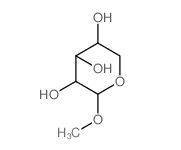
IUPAC Name (2S,3R,4S,5S)-2-methoxyoxane-3,4,5-triol
Molecular Formula C6H12O5
Molecular Weight 164.16 g/mol
InChI InChI=1S/C6H12O5/c1-10-6-5(9)4(8)3(7)2-11-6/h3-9H,2H2,1H3/t3-,4-,5+,6-/m0/s1
InChI Key ZBDGHWFPLXXWRD-AZGQCCRYSA-N
SMILES COC1C(C(C(CO1)O)O)O
Synonyms ?-L-Arabinopyranoside Methyl Ether; NSC 25272;
Canonical SMILES COC1C(C(C(CO1)O)O)O
Isomeric SMILES CO[C@@H]1[C@@H]([C@H]([C@H](CO1)O)O)O
CAS No: 1825-00-9 Synonyms: Methyl b-arabinoside MDL No: MFCD00047547 Chemical Formula: C6H12O5 Molecular Weight: 164.16
References: 1. Evtushenko EV, Ovodov YS, Chem. Nat. Compd. 1978, Vol13, No6, p634-636