About this product
Methyl beta-L-fucopyranoside is a monosaccharide compound that is commonly found in the cell wall of many organisms, particularly bacteria and fungi. It is a form of fucose, which is a part of the family of sugars known as fucosylated glycans. The compound has been the subject of extensive research in recent years, due to its potential biological and medical applications. In this paper, we will discuss the definition and background of methyl beta-L-fucopyranoside, its physical and chemical properties, synthesis and characterization, analytical methods, biological properties, toxicity and safety in scientific experiments, applications in scientific experiments, current state of research, potential implications in various fields of research and industry, and limitations and future directions.
Definition and background
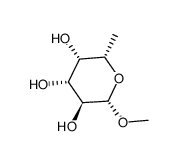
Methyl beta-L-fucopyranoside is a monosaccharide that consists of a six-carbon ring with a single oxygen atom attached to it. It is a member of the fucosylated glycans family, which includes other complex sugar molecules such as fucoidan and fucose-containing polysaccharides. The compound is widely distributed in the cell wall of many organisms, including bacteria, fungi, and some plants. It has also been found to be present in certain animal tissues.
Physical and Chemical Properties
Methyl beta-L-fucopyranoside is a white crystalline powder that is soluble in water and alcohols. Its molecular formula is C7H14O5, and its molecular weight is 178.183 g/mol. The compound has a melting point of 179-182?C and a specific rotation of -22? (c=5, H2O). Its pH is neutral, and it is stable at room temperature for an extended period of time. Methyl beta-L-fucopyranoside possesses several chemical properties such as it is a reducing sugar and reacts with reactive amine groups under mild condition.
Synthesis and Characterization
Methyl beta-L-fucopyranoside can be synthesized through a variety of methods, including chemical synthesis and extraction from natural sources. Chemical synthesis involves the use of various chemical reagents to create the compound from simpler chemical precursors. The extraction process involves the extraction of the compound from natural sources such as brown algae, shrimp shells, or fungal cell walls.
The characterization of Methyl beta-L-fucopyranoside can be done through various techniques such as NMR, IR, and Mass spectroscopy. These techniques validate the chemical structure of Methyl beta-L-fucopyranoside and its purity.
Analytical Methods
The analysis of Methyl beta-L-fucopyranoside can be done through various methods such as Liquid chromatography-mass spectrometry (LC/MS) and Nuclear magnetic resonance spectroscopy (NMR). LC/MS is used to differentiate the isomers among other molecules while NMR is used for the confirmation of the chemical structure.
Biological Properties
Methyl beta-L-fucopyranoside has been associated with various biological properties, such as antimicrobial activity and immunomodulatory effects. Research has demonstrated that Methyl beta-L-fucopyranoside can interact with various biological molecules such as lectins, cytokines, and enzymes, leading to different biological activities. It is known to modulate the immune system and to possess anti-inflammatory abilities.
Toxicity and Safety in Scientific Experiments
The toxicity of Methyl beta-L-fucopyranoside is limited in biological systems. No significant toxicity has been reported to date. Certain formulation and application conditions may be harmful, but systematic toxicity evaluation is required to confirm the safety of the compound in different experimental settings.
Applications in Scientific Experiments
Methyl beta-L-fucopyranoside is known to be involved in various scientific experiments due to its unique structure and biological activity. Its biological properties render it useful in various biotechnological applications, including the development of drugs and vaccines, immunoassays, and as prebiotics. It can act as a surfactant and can be employed in the creation of nanoparticles for delivery purposes.
Current State of Research
The current body of research on Methyl beta-L-fucopyranoside includes a broad range of studies exploring its biological properties and possible applications in various fields. Many investigations have focused on the effects of Methyl beta-L-fucopyranoside on the immune system, its antimicrobial activity, and its potential as a treatment for a range of diseases. Other studies have explored its potential use in the cosmetics and food industries.
Potential Implications in Various Fields of Research and Industry
Methyl beta-L-fucopyranoside has various potential implications in different fields of research, including biotechnology, biomedicine, and cosmetics. In the biotechnology area, it could be employed as drug targets and vaccine candidates. In the pharmaceutical industry, Methyl beta-L-fucopyranoside has been assessed as a tool for the diagnosis and treatment of various diseases, including tumors, inflammation, and bacterial infections.
In cosmetics, Methyl beta-L-fucopyranoside has shown a broad range of biological activities such as moisturizing and anti-inflammatory properties. Therefore, it can be used as an active ingredient in the cosmetic industry.
Limitations and Future Directions
Despite widespread research, a significant limitation of Methyl beta-L-fucopyranoside is its limited availability. The limited synthetic access to complex and bioactive forms of Methyl beta-L-fucopyranoside hinders various studies that could employ it as a tool for biomedical research.
The future directions for the research on the compound include the investigation of the novel biological properties of Methyl beta-L-fucopyranoside and the development of novel synthesis methods. Methyl beta-L-fucopyranoside can be used as an immunomodulator, and future studies need to investigate its systemic action in biological organisms. Additionally, future studies could examine the use of Methyl beta-L-fucopyranoside in the food industry as flavorings, and for the treatment of metabolic disorders.
CAS Number 24332-98-7
Product Name Methyl beta-L-Fucopyranoside
IUPAC Name (2S,3S,4R,5S,6S)-2-methoxy-6-methyloxane-3,4,5-triol
Molecular Formula C7H14O5
Molecular Weight 178.183 g/mol
InChI InChI=1S/C7H14O5/c1-3-4(8)5(9)6(10)7(11-2)12-3/h3-10H,1-2H3/t3-,4+,5+,6-,7-/m0/s1
InChI Key OHWCAVRRXKJCRB-XUVCUMPTSA-N
SMILES CC1C(C(C(C(O1)OC)O)O)O
Canonical SMILES CC1C(C(C(C(O1)OC)O)O)O
Isomeric SMILES C[C@H]1[C@H]([C@H]([C@@H]([C@H](O1)OC)O)O)O
CAS No: 24332-98-7 MDL No: MFCD00069803 Chemical Formula: C7H14O5 Molecular Weight: 178.183
References: 1. Hirsch J, et al., J. Mass Spectrom. Vol36, Issue 4, p379-383