About this product
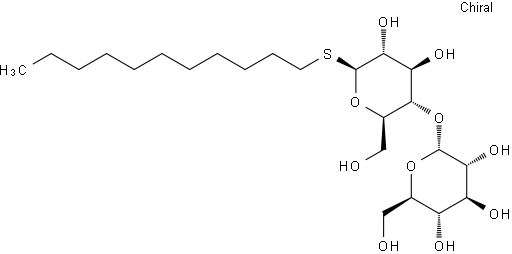
n-Undecyl-β-D-Thiomaltopyranoside
n-Undecyl-β-D-Thiomaltopyranoside is a nonionic surfactant and a glycoside derivative that is commonly used in biochemical and biophysical research. It serves as a detergent for solubilizing membrane proteins and stabilizing them in solution, making it essential for various applications in molecular biology.
Chemical Properties
CAS Number : 148565-57-5
MDL No. : MFCD09750651
Catalog Number : A808785
EINECS : 1533716-785-6
Molecular Formula : C₂₃H₄₄O₁₀S
Molecular Weight : 512.65 g/mol
Boiling Point : 724.4 ± 60.0 °C
Density : 1.32 ± 0.1 g/cm³
Appearance : Not specified (typically a colorless to pale yellow liquid or solid)
Storage Conditions : Store at 2–8 °C for long-term stability (months).
Applications
Membrane Protein Solubilization :
n-Undecyl-β-D-thiomaltopyranoside is primarily used as a detergent to solubilize membrane proteins while maintaining their functional integrity. This property is crucial for structural studies, functional assays, and purification processes.
Biochemical Research :
It is utilized in various biochemical assays and experiments involving membrane proteins, enzymes, and receptors, aiding in the study of protein-lipid interactions and protein folding.
Detergent in Cell Lysis :
Acts as a nonionic detergent for cell lysis, facilitating the extraction of proteins from cells without denaturing them, which is vital for downstream applications such as Western blotting and enzyme assays.
Stabilization of Proteins :
Provides stabilization to proteins in solution, preventing aggregation and denaturation during experimental procedures.
Safety Profile
While specific safety data for n-undecyl-β-D-thiomaltopyranoside may be limited, standard laboratory safety protocols should be followed when handling this compound. Use appropriate personal protective equipment (PPE) to minimize exposure.
Conclusion
n-Undecyl-β-D-Thiomaltopyranoside (CAS No. 148565-57-5) is an important nonionic surfactant used in biochemical research for solubilizing and stabilizing membrane proteins. Its properties make it essential for various applications in molecular biology and biochemistry.
Citations:
https://www.chemicalbook.com/ChemicalProductProperty_EN_CB2511418.htm
https://pmc.ncbi.nlm.nih.gov/articles/PMC10693435/
https://journals.asm.org/doi/10.1128/jb.00642-20
https://www.sigmaaldrich.com/deepweb/assets/sigmaaldrich/product/documents/256/387/detergent-selection-guide.pdf
https://anatrace.com/category/u342-n-undecyl-v-d-thiomaltopyranoside-anagrade
https://pubchem.ncbi.nlm.nih.gov/compound/44134986
https://anatrace.com/product/U342-1-GM
https://moleculardimensions.com/product/U342-25-GM