About this product
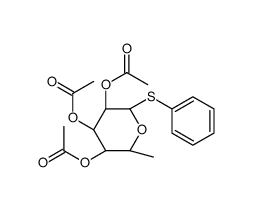
Phenyl 2,3,4-tri-O-acetyl-a-L-thiorhamnopyranoside
Phenyl 2,3,4-Tri-O-acetyl-1-thio-alpha-L-rhamnopyranoside (PTART) is a chemical compound that belongs to the class of carbohydrates. It has been used widely in research for its various physical, chemical, and biological properties. In this paper, we will focus on the definition, synthesis, characterization, analytical methods, biological properties, toxicity, safety, scientific applications, current state of research, potential implications in various fields of research, industry limitations, and future directions related to PTART.
Definition and background:
Phenyl 2,3,4-Tri-O-acetyl-1-thio-alpha-L-rhamnopyranoside is a derivative of the rhamnose carbohydrate family. It is a white solid crystalline powder that is soluble in organic solvents like chloroform, acetone, and methanol. It is derived from the naturally occurring rhamnose, which is a very important constituent of many biologically active compounds. PTART had been synthesized first in the 1980s and has since found many applications in various fields of research due to its unique properties.
Synthesis and characterization:
PTART can be synthesized through various methods, such as the reaction of rhamnose with phenyl thioacetate in the presence of acetic anhydride and sulfuric acid. It can also be synthesized through the reaction of rhamnose with phenyl disulfide in the presence of sodium hydroxide and acetic acid. Many characterization techniques such as NMR, mass spectrometry, and IR spectroscopy have been used to identify and confirm the structure of PTART.
Analytical methods:
Various analytical methods have been used to detect and quantify PTART in biological and chemical systems. These methods include thin layer chromatography, high-performance liquid chromatography, Fourier transform infrared spectroscopy, and mass spectrometry. These methods have proven to be effective in identifying and quantifying PTART in varied sample types.
Biological properties:
PTART has been studied for its various biological properties. Studies have suggested that PTART has anticancer, anti-inflammatory, and antiviral activities. It has also been found to be effective against various bacterial and fungal infections. PTART has shown much potential in drug design and development, and many researchers are currently investigating its use in various forms of treatment.
Toxicity and safety in scientific experiments:
Studies have shown that PTART is safe and well-tolerated in scientific experiments when used at recommended doses. However, like every chemical compound, PTART possesses some hazards, and researchers should take appropriate measures to ensure safety to avoid harm and toxicity during scientific experiments.
Applications in scientific experiments:
PTART has many applications in scientific research. It has been used as a precursor for the synthesis of other biologically active compounds. Furthermore, PTART has been found to be useful in assaying the activity of various enzymes and receptors, such as glycosidases, fucosyltransferases, and sialyltransferases. PTART has also been used in developing biosensors and other various diagnostic tools.
Current state of research:
PTART research is still ongoing, and many researchers are continually looking at its potential applications. Currently, PTART is being investigated for its use in drug design and development, as well as for its potential applications in various fields of research.
Potential implications in various fields of research and industry:
PTART has many implications in various fields of research and industry. It has shown high potential for use in drug development and design, and it may be used for developing new therapeutic agents to fight against cancer, bacterial, and viral infections. It can also be used as an effective building block for synthesizing analogs of other biologically active compounds. Additionally, PTART may show effective applications in developing biosensors and diagnostic tools for the early detection of certain diseases.
Limitations and future directions:
Despite its promising results in scientific research, PTART has some limitations, which include issues related to its synthesis, identification, and purity. In the future, further research may focus on developing new and improved methods for synthesizing, purifying, and identifying PTART. Furthermore, research on its various biological activities and potential applications may help identify new avenues for its use in various fields of research and industry.
Future directions:
Future research directions can include synthesizing and studying structure-activity relationships of PTART analogs and analyzing their biological activities and mechanisms of actions. The development of a better understanding of the biological mechanisms implicated in PTART's bioactivities would potentially lead to new therapeutic applications for PTART. Developing better analytical methods for detecting and quantifying PTART would allow researchers to investigate its pharmacology, both within in vitro and in vivo biological systems. Finally, conducting clinical trials involving PTART would help determine its potential for use in treating various diseases in humans.
CAS Number 108740-74-5
Product Name Phenyl 2,3,4-Tri-O-acetyl-1-thio-alpha-L-rhamnopyranoside
IUPAC Name [(3S,6S)-4,5-diacetyloxy-2-methyl-6-phenylsulfanyloxan-3-yl] acetate
Molecular Formula C18H22O7S
Molecular Weight 382.43
InChI InChI=1S/C18H22O7S/c1-10-15(23-11(2)19)16(24-12(3)20)17(25-13(4)21)18(22-10)26-14-8-6-5-7-9-14/h5-10,15-18H,1-4H3/t10?,15-,16?,17?,18-/m0/s1
SMILES CC1C(C(C(C(O1)SC2=CC=CC=C2)OC(=O)C)OC(=O)C)OC(=O)C
Synonyms Phenyl 6-Deoxy-1-thio-?-L-mannopyranoside Triacetate;
CAS No: 108740-74-5
MDL No: MFCD09841185
Chemical Formula: C18H22O7S
Molecular Weight: 382.43