About this product
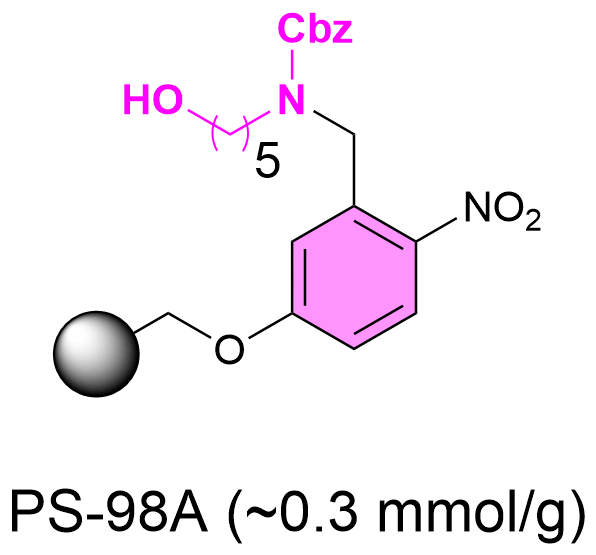
Polystyrene-linked-benzyl (5-hydroxy-2-nitrobenzyl)(5-hydroxypentyl)carbamate
Polystyrene-linked-benzyl (5-hydroxy-2-nitrobenzyl)(5-hydroxypentyl)carbamate is a functionalized polymer support designed for solid-phase organic synthesis. Its structure and properties can be described as follows:
Structural Features
Polystyrene backbone :
A crosslinked polystyrene matrix provides mechanical stability and insolubility in common solvents.
The aromatic rings in polystyrene enable covalent attachment of functional groups via electrophilic substitution or linker chemistry.
Benzyl carbamate moiety :
A carbamate group (-OC(O)NH-) bridges the polystyrene backbone to two substituents:
5-Hydroxy-2-nitrobenzyl : Contains a nitro group (electron-withdrawing) at position 2 and a hydroxyl group (polar/reactive) at position 5.
5-Hydroxypentyl : A five-carbon alkyl chain terminating in a hydroxyl group, enhancing hydrophilicity.
Key Properties
Solubility : Insoluble in water and most organic solvents due to crosslinked polystyrene, enabling easy filtration-based purification.
Reactivity :
Nitro group facilitates redox reactions or acts as a directing group in electrophilic substitutions.
Hydroxyl groups (benzyl and pentyl) allow further derivatization (e.g., phosphorylation, glycosylation).
Thermal stability : Inherits polystyrene’s stability up to ~200°C, suitable for high-temperature reactions.
Synthetic Applications
Solid-phase synthesis :
Used as a reusable scaffold for stepwise peptide or small-molecule assembly.
Carbamate acts as a cleavable linker under basic or nucleophilic conditions (e.g., NH₃/MeOH).
Catalyst support :
Immobilizes metal catalysts via nitro or hydroxyl groups for heterogeneous catalysis.
Protecting group strategy :
Temporarily masks amines during multi-step syntheses, with orthogonal deprotection options.
Functional Advantages
Eco-friendly processing : Minimizes solvent waste compared to solution-phase synthesis.
Tunable morphology : Crosslinking density adjusts porosity for controlled reagent diffusion.
Safety : Reduced exposure to toxic intermediates due to solid-phase handling.
This compound exemplifies the integration of polymer chemistry and organic synthesis for sustainable, high-efficiency methodologies.
Citations:
https://onlinelibrary.wiley.com/doi/10.1002/polb.23170
https://testbook.com/chemistry/polystyrene
https://www.chemicalbook.com/ChemicalProductProperty_EN_CB5100170.htm
https://www.mdpi.com/1420-3049/28/22/7648
https://pubchem.ncbi.nlm.nih.gov/compound/Benzyl-carbamate
https://onlinelibrary.wiley.com/doi/full/10.1002/macp.202100127
https://en.wikipedia.org/wiki/Benzyl_carbamate
https://www.sciencedirect.com/science/article/abs/pii/S0016236107000312