About this product
Potassium D-erythronate
Potassium D-erythronate is a compound of interest in scientific research and industry because of its potential applications in various fields. This paper provides information on the definition and background of potassium D-erythronate, physical and chemical properties, synthesis and characterization, analytical methods, biological properties, toxicity and safety in scientific experiments, applications in scientific experiments, current state of research, potential implications in various fields of research and industry, limitations, and future directions.
Definition and Background
Potassium D-erythronate is a chemical compound that belongs to the class of erythroses. Erythroses are monosaccharides that have four carbon atoms and one ketone group. Potassium D-erythronate is a white crystalline powder that is soluble in water and methanol. It is used as a reagent in organic synthesis and as a substrate for enzymes involved in the metabolism of carbohydrates.
Physical and Chemical Properties
Potassium D-erythronate has a melting point of 157-162 ?C and a molecular weight of 174.19 g/mol. Its molecular formula is C4H7O5K. The compound is stable when stored in a dry and cool place. However, it can decompose when exposed to heat or light.
Synthesis and Characterization
Potassium D-erythronate can be synthesized through the oxidation of D-erythrose with potassium hydroxide and hydrogen peroxide. The product is then purified through recrystallization. The compound can be characterized through various techniques such as infrared spectroscopy, nuclear magnetic resonance spectroscopy, and X-ray crystallography.
Analytical Methods
Potassium D-erythronate can be analyzed through various analytical methods such as high-performance liquid chromatography, gas chromatography, and mass spectrometry. These methods can be used to determine the purity of the compound and identify impurities.
Biological Properties
Potassium D-erythronate has been found to have antimicrobial, antitumor, and anti-inflammatory properties. It has also been shown to lower blood glucose levels and improve insulin sensitivity. However, further studies are needed to fully understand the biological properties and mechanisms of action of the compound.
Toxicity and Safety in Scientific Experiments
Potassium D-erythronate has been found to be non-toxic at low concentrations. However, high concentrations can be cytotoxic and cause cell death. It is important to handle the compound with care and follow safety protocols when conducting experiments.
Applications in Scientific Experiments
Potassium D-erythronate has various applications in scientific experiments. It is used as a substrate for enzymes involved in carbohydrate metabolism. It can also be used as a reagent in organic synthesis and as a chiral building block for the synthesis of biologically active compounds.
Current State of Research
Research on potassium D-erythronate is still ongoing. Studies have focused on the synthesis, characterization, and biological properties of the compound. However, more research is needed to fully understand the potential applications of the compound in various fields.
Potential Implications in Various Fields of Research and Industry
Potassium D-erythronate has potential implications in various fields of research and industry. In medicine, it can be used as a potential treatment for diabetes and cancer. In agriculture, it can be used as a biopesticide. In the food industry, it can be used as a natural preservative.
Limitations
One major limitation of potassium D-erythronate is its low solubility in organic solvents. This can make it difficult to use in certain organic reactions. Another limitation is the lack of comprehensive studies on its toxicity and safety.
Future Directions
There are several future directions for research on potassium D-erythronate. These include developing methods to improve the solubility of the compound, conducting more in-depth studies on its biological properties and mechanisms of action, and exploring its potential applications in various fields such as medicine, agriculture, and food industry. Other potential future directions include evaluating its use as a potential drug delivery system and investigating its interactions with other compounds.
Conclusion
Potassium D-erythronate is a compound of interest in scientific research and industry because of its potential applications in various fields. It has antimicrobial, antitumor, and anti-inflammatory properties and can lower blood glucose levels and improve insulin sensitivity. Further studies are needed to fully understand its biological properties and mechanisms of action. Potassium D-erythronate has potential implications in fields such as medicine, agriculture, and food industry. However, it has limitations such as low solubility and lack of comprehensive studies on its toxicity and safety. Future directions for research include improving its solubility, conducting more in-depth studies, and exploring its potential applications.
CAS Number 88759-55-1
Product Name Potassium D-erythronate
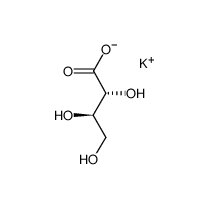
IUPAC Name potassium;(2R,3R)-2,3,4-trihydroxybutanoate
Molecular Formula C4H7KO5
Molecular Weight 174.19 g/mol
InChI InChI=1S/C4H8O5.K/c5-1-2(6)3(7)4(8)9;/h2-3,5-7H,1H2,(H,8,9);/q;+1/p-1/t2-,3-;/m1./s1
InChI Key NIBJBHRBFKKLFG-SWLXLVAMSA-M
SMILES C(C(C(C(=O)[O-])O)O)O.[K+]
Canonical SMILES C(C(C(C(=O)[O-])O)O)O.[K+]
Isomeric SMILES C([C@H]([C@H](C(=O)[O-])O)O)O.[K+]
CAS No: 88759-55-1
Synonyms: 2,3,4-Trihydroxybutanoic acid potassium salt
MDL No: MFCD00080810
Chemical Formula: C4H7KO5
Molecular Weight: 174.19