About this product
RSL (Ralstonia Solanacearum Lectin) is indeed a high-purity laboratory reagent designed for research and development purposes only, not intended for human or animal use 7 . This lectin is known for its specific carbohydrate-binding properties and is widely used in studies related to bacterial adhesion, host-pathogen interactions, and glycobiology.
Key characteristics of RSL include:
Molecular weight: 9.9 kDa per monomer 7
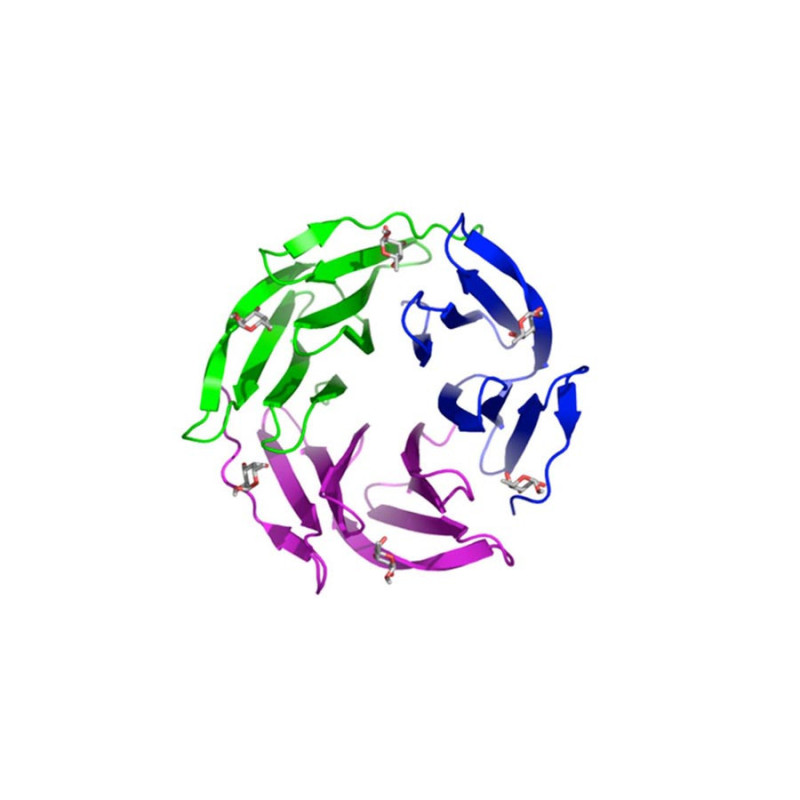
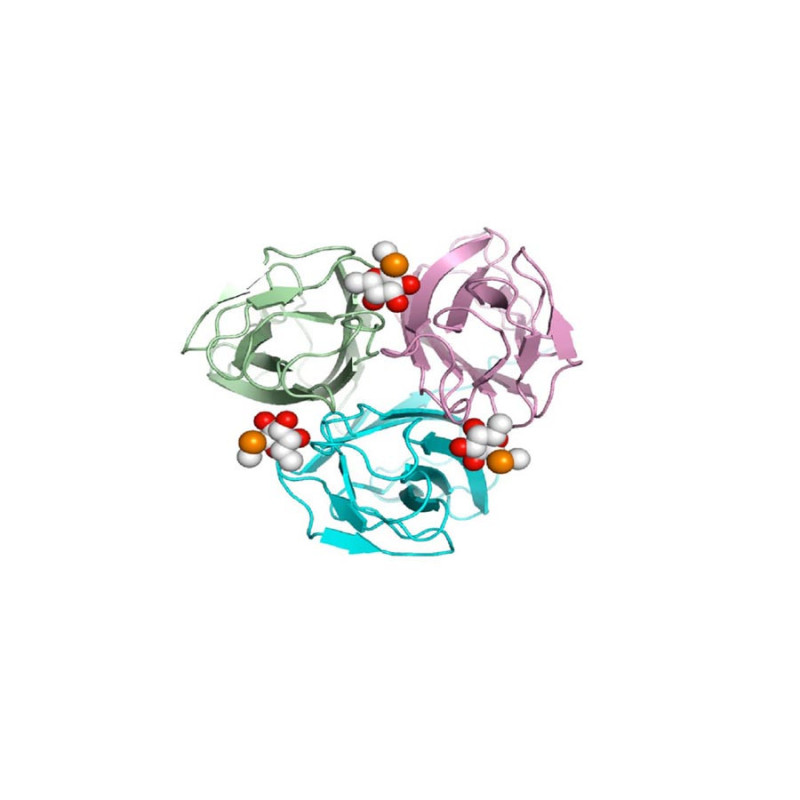
Structure: Forms a trimeric structure, generating a six-bladed β-propeller architecture 1
Binding specificity: High affinity for L-fucose and its derivatives, particularly α-Fuc1-2Gal and α-Fuc1-6Gal epitopes 1
RSL has been extensively studied for its role in plant pathogenesis:
It is produced by Ralstonia solanacearum, a bacterium that causes lethal wilt in many agricultural crops worldwide 1
The lectin is involved in host recognition, attachment, and invasion strategies of the pathogen 1
It has an unusually high affinity for α-Fuc1-2Gal-containing oligosaccharides, with a dissociation constant (KD) of 2.5 × 10^-7 M for 2-fucosyllactose 1
Recent research has provided insights into the structure and function of RSL:
X-ray crystallography has revealed that each monomer consists of two small four-stranded anti-parallel β-sheets 1
The lectin has been crystallized with various ligands, including methyl-α-L-fucoside and 2-fucosyllactose 1 6
Computational studies have been conducted to calculate the absolute binding free energy of RSL in complex with methyl-α-L-fucoside 6
RSL's potential biological target may be xyloglucan, a fucosylated polysaccharide found in the primary cell wall of plants 1 . This interaction could play a crucial role in the pathogen's ability to colonize and infect host plants.
In summary, RSL is a valuable tool for researchers studying plant-pathogen interactions, bacterial adhesion mechanisms, and carbohydrate-protein interactions in various biological systems.
Citations:
https://pubmed.ncbi.nlm.nih.gov/15923179/
https://pmc.ncbi.nlm.nih.gov/articles/PMC11449490/
https://vectorlabs.com/products/rhodamine-labeled-gsl-i/
http://www.xray.cz/setkani/abst2014/pokorny.htm
https://pmc.ncbi.nlm.nih.gov/articles/PMC6638453/
https://pubs.rsc.org/en/content/articlehtml/2017/ra/c7ra06215j
https://www.elicityl-oligotech.com/free-lectins/578-rsl-from-ralstonia-solanacearum---bacterial-protein-produced-in-e--coli.html
https://onlinelibrary.wiley.com/doi/10.1111/j.1365-2958.2004.04020.x